TLDR: Every test, win or lose, leaves you knowing something about your customers you did not know before. Those facts accumulate into a private understanding of what actually works for your business, an advantage no competitor can copy and no best-practice article can hand you. Skip testing and you bank none of it. You pay to relearn the same lessons, and the same arguments come back every year because nothing was ever settled.
Click to discuss this article with your favourite AI
The last article ended on a bonus the room never sees. Run a test and, win or lose, you come away knowing something you did not know an hour before. This article is about what happens when you do that again, and again, and what happens to the businesses that never do.
A test that fails still buys you something
You may call a test that does not produce a lift a failure. It is not. You spent a small, fixed amount and you bought a fact: this specific idea does not move your numbers. That fact is yours to keep, and it is worth having. It stops you building the same wrong thing twice and it points you at what to try next.
The real waste is the other thing. It is the feature you shipped without a test, that you cannot read, that you will now pile more work on top of without ever knowing whether it earned its place. A failed test is a receipt. An untested feature is a guess wearing a suit.
The facts add up, and that is the entire point
One fact is trivia. A hundred facts about how your customers actually behave is a map. Every test rules something in or out, so the next decision starts from a smaller and better lit space than the last one. A business two years into a testing habit is not simply measuring things. It is operating on a hard-won understanding of its own customers that it no longer has to guess at.
And the distance between that business and one still running on opinion does not hold steady. It widens. Every quarter, one of them banks a little more of what works and the other starts from scratch again. Compounding is a quiet force. You do not notice it in any single week, and then one year you look up and the gap is enormous.
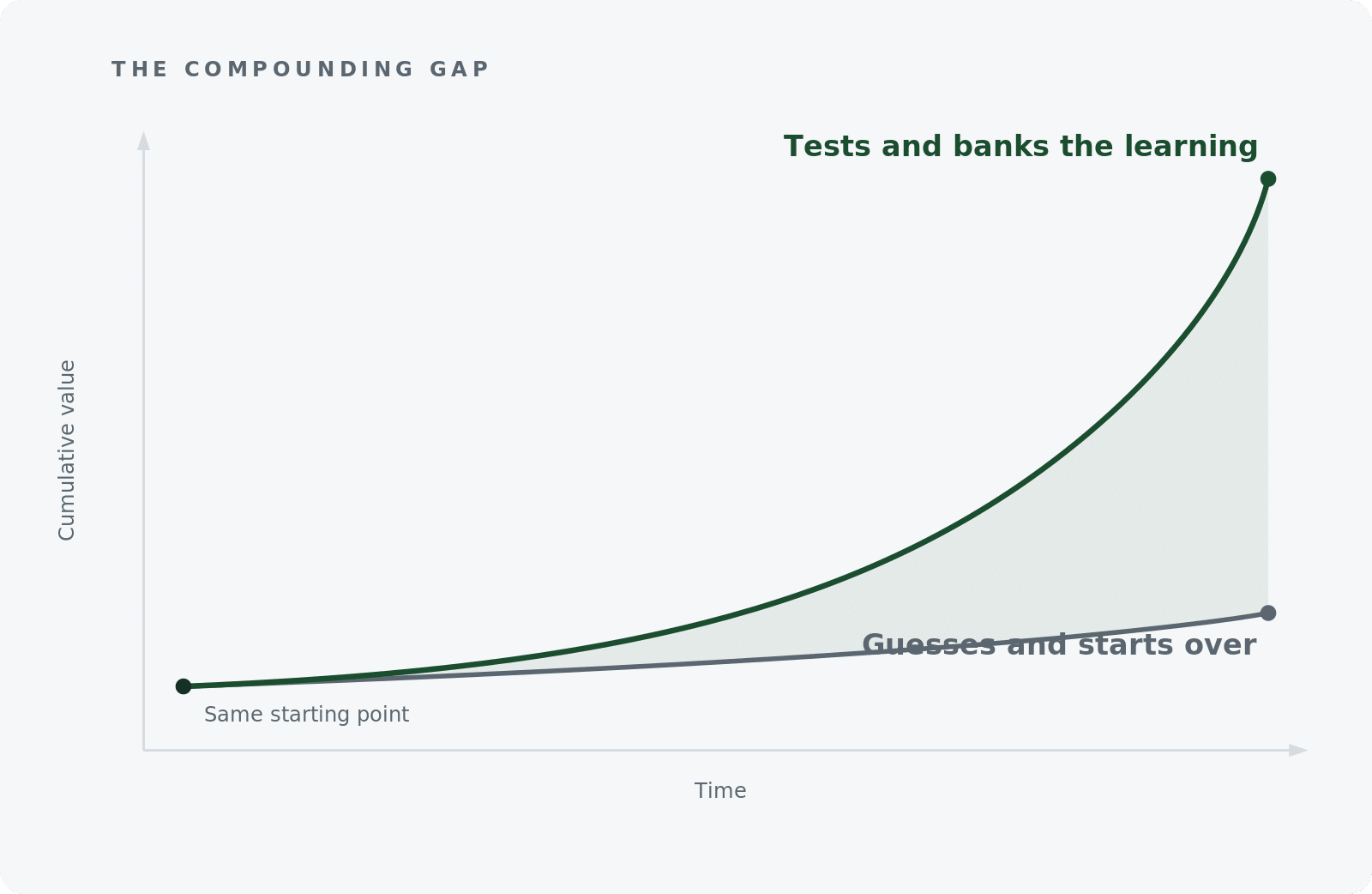
The compounding gap: two businesses start at the same point, and the one that tests and banks its learning curves upward and away from the one that keeps guessing
It is the one advantage you cannot buy or copy
This advantage is worth dwelling on, because it is rare. The understanding you build by testing is specific to your customers, your product and your context. You will not find it in a best-practices article, because what works for someone else’s audience is often wrong for yours. The single-page checkout from part one was best practice. It was also costing that business a fifth of its conversions.
A competitor cannot copy this advantage, because they cannot see it. You cannot shortcut to it, because the only way to hold it is to have run the tests. It is the unusual kind of advantage that grows the longer you own it and that nobody can lift from you. Most businesses are sitting on the raw material for it and throwing it out with every untested release.
What it costs to never bank it
Guess instead of test and none of it accumulates. Every decision starts from zero, and the same arguments come back on a loop. Should we show the price on the page. Should we shorten the form. Should we put the signup in front of the guide or behind it. Every business has three or four of these, and without a test they get settled by whoever is most persuasive in the meeting, which means they are never settled at all. You have the same argument next year, with new people, and no evidence to end it.
There is a staffing cost buried in that too. When knowledge lives in tests, it stays in the business. When it lives in opinions, it walks out the door every time someone leaves. A team that never banks its learning is condemned to keep paying for the same lessons, hire after hire.
The number worth watching is not your win rate
If you take one measure from all of this, do not make it how often your tests win. Make it how much you learn per test, losses firmly included. A team that only celebrates the wins is binning most of what it paid for, because the losing and inconclusive tests are usually where the sharpest, most surprising lessons are hiding. I have written before about why a high win rate should quietly worry you rather than reassure you. The wins feel good. The learning is where the money is.
Which brings us to the obvious objection
All of this assumes you can test in the first place. And right now some of you are thinking that it is fine for a business with traffic to spare and time to burn, and that you have neither. That is the most common objection there is, and it is the one I take on next. The short version, the one that tends to surprise people, is that being small is a reason to start, not a reason to wait.
Ready to start learning how to do things better?
The most valuable thing your team produces is not the work, it is what you learn from doing it, and most businesses throw that away. I help teams build the habit that keeps it.